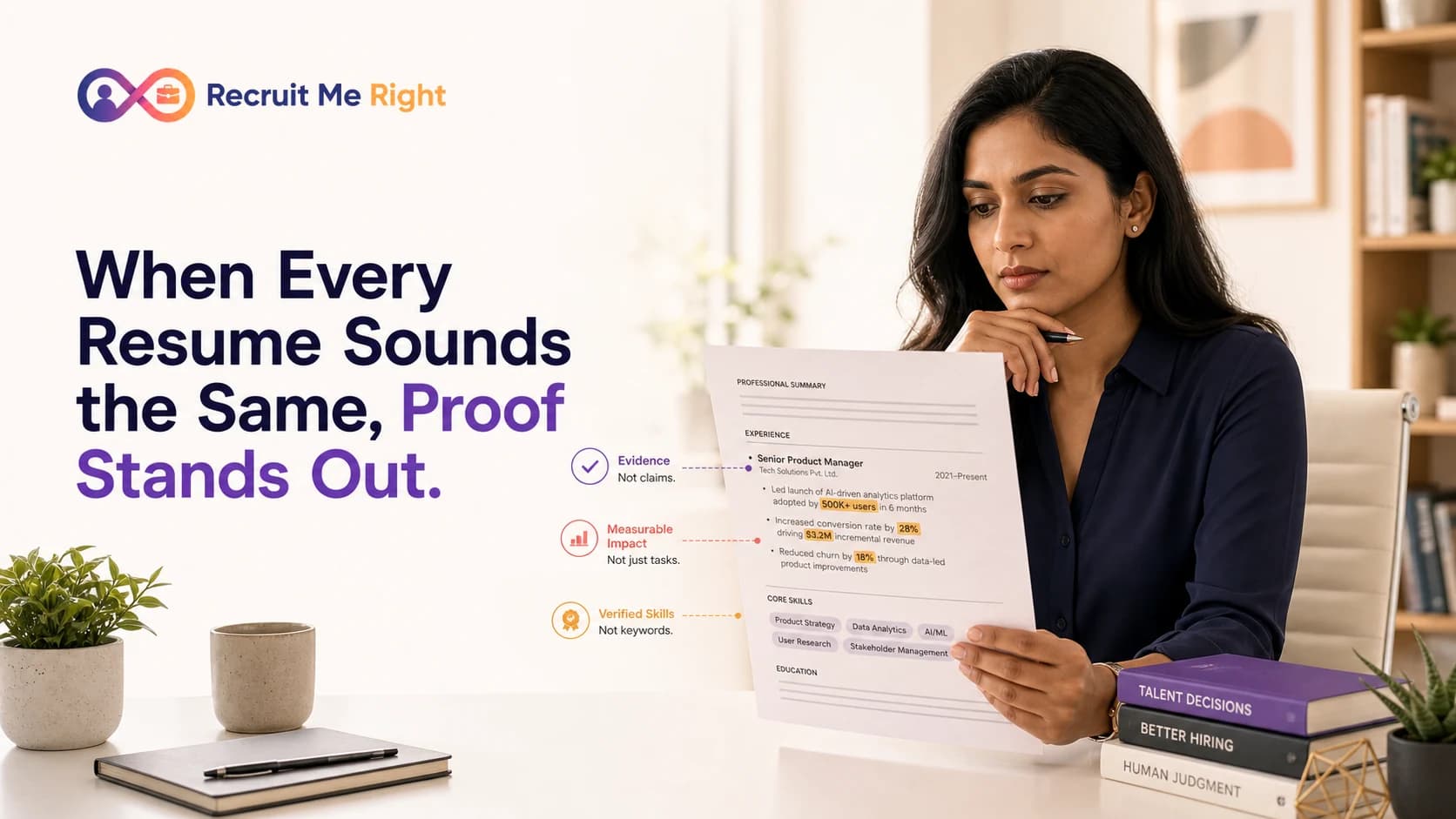
Key Takeaways & Executive Summary
- An ATS-friendly resume can help you enter the screening process; evidence of relevant work helps you move beyond it.
- Strong resume bullets explain the problem, your action, the scale of the work and the result.
- Freshers and career switchers can prove capability through projects, work samples, portfolios and realistic problem-solving.
- Use AI to organise and edit facts you can defend, never to invent achievements, numbers or expertise.
Two resumes can describe the same person and create completely different levels of confidence.
The first says:
Results-driven professional who leveraged cross-functional collaboration to optimise operational efficiency.
The second says:
Rebuilt the weekly reporting process for three teams, reduced manual follow-ups and delivered accurate numbers to management one day earlier.
Both sentences sound professional. Only one tells a recruiter what the candidate actually did.
That difference matters more now because AI can improve grammar, reorganise experience and produce polished resume language within minutes. Recent LinkedIn hiring data reported by The Indian Express found that application volume per open role in India has more than doubled since 2022, while recruiters are finding it harder to distinguish genuine candidates from low-effort or misleading applications.
If you want to know how to make your resume stand out, the answer is not to sound more impressive than everyone else. It is to make your experience easier to understand, verify and remember.
This guide explains how recruiters evaluate credibility, how to write evidence-based achievements, how freshers can prove skills without extensive experience and how to use AI without losing your professional voice.
What Makes a Resume Stand Out in the AI Era?
A credible resume gives the reader useful signals quickly. It does not force the recruiter to guess what a broad claim means.
The strongest resumes usually contain:
- Clear role relevance: The experience and skills most important to the target job appear early.
- Specific actions: Bullets explain what the candidate personally created, improved, analysed, sold, supported or delivered.
- Useful context: The reader can see the scale, frequency, difficulty or business purpose of the work.
- Observable outcomes: Results are expressed through numbers, time saved, quality improved, risk reduced or a clear operational change.
- Consistent evidence: The resume, LinkedIn profile, portfolio and interview answers support the same professional story.
- A natural voice: The language is polished but still sounds like something the candidate can explain confidently.
An Applicant Tracking System may help determine whether your resume is readable and relevant. A recruiter then asks a different question: Is there enough evidence here to justify a conversation?
Why Generic AI-Written Resumes Are Easy to Ignore
AI is good at producing familiar professional language. That is useful when your original writing is unclear, but it becomes a problem when every bullet uses the same vague formula.
Recruiters regularly see phrases such as:
- Results-driven professional
- Proven track record of success
- Excellent communication skills
- Strategic thinker and team player
- Leveraged cross-functional collaboration
- Responsible for driving operational excellence
These phrases are not automatically wrong. They are simply incomplete. They describe a positive quality without showing the work that proves it.
Consider the difference:
Improved customer engagement through effective communication.
Contacted 40 to 50 inactive customers each week, documented common objections and helped reactivate 12 accounts during a three-month campaign.
The second version gives the recruiter action, scale and outcome. It also creates useful interview questions. The recruiter can ask what objections appeared most often, how the candidate handled them and what contributed to the reactivations.
Credible details make a resume more interesting because they create a picture of the candidate at work.
Use the Problem-Action-Scale-Result Framework
You do not need to be a professional writer to create strong resume achievements. Start with four pieces of information:
- Problem: What needed to be fixed, improved, delivered or understood?
- Action: What did you personally do?
- Scale: How large, frequent, complex or important was the work?
- Result: What changed after your contribution?
Not every bullet needs all four elements in one long sentence. The framework is a thinking tool that helps you identify the strongest facts.
Problem
Briefly show why the work mattered. Was a process slow? Was information scattered? Were leads going cold? Was a team missing visibility?
Action
Use a precise verb that reflects your contribution: created, analysed, negotiated, redesigned, coordinated, tested, resolved, launched or trained.
Avoid hiding behind “responsible for.” It describes ownership but not execution.
Scale
Scale can be expressed in several ways:
- Number of customers, candidates, records, campaigns or locations
- Weekly or monthly frequency
- Size of the budget, team or territory
- Number of stakeholders involved
- Turnaround time or project duration
- Technical or operational complexity
Result
A result does not always need to be revenue or a dramatic percentage. A valid outcome may be:
- Faster turnaround
- Fewer errors or follow-ups
- Better visibility for decision-makers
- Higher response or completion rates
- A successful launch or on-time delivery
- Reduced risk, duplication or confusion
- A repeatable process that did not exist before
For example:
Created a candidate-tracking sheet for five open roles, giving the hiring team one view of interview status, feedback and pending actions.
This is more credible than “streamlined recruitment operations” because the reader understands what was built, who used it and why it helped.
Turn Job Responsibilities into Resume Achievements
Many candidates know what they were responsible for but struggle to explain what they contributed. The easiest way forward is to ask better questions about ordinary work.
Recruitment example
Weak:
Responsible for candidate coordination and interview scheduling.
Stronger:
Coordinated interview schedules for up to 20 candidates each week across hiring managers and panel members, tracked pending feedback and reduced avoidable rescheduling.
Operations example
Weak:
Managed daily reports and supported the team.
Stronger:
Consolidated daily updates from four team leads into one reporting format, flagged missing data before submission and improved management visibility on pending work.
Sales example
Weak:
Worked on lead generation and client relationships.
Stronger:
Researched and qualified 30 to 40 prospects each week, maintained follow-up notes in the CRM and supported the sales team with better-prepared discovery calls.
Marketing example
Weak:
Created social media content for the brand.
Stronger:
Planned a four-week content calendar, wrote platform-specific posts and reviewed engagement patterns to refine the next month’s topics.
The stronger examples do not rely on inflated claims. They show a repeatable activity, the candidate’s role and the value created.
Show Proof of Skills Instead of Listing Keywords
A skills section helps with scanning and keyword alignment, but a list alone does not demonstrate capability. Important skills should appear again in your experience or project bullets.
If you list data analysis, show:
- The type of data you worked with
- The tool you used
- The question you investigated
- The decision, insight or output produced
If you list stakeholder management, show:
- Who the stakeholders were
- What information or decision you coordinated
- What conflict, delay or dependency you managed
- How the work moved forward
You can also link to evidence when it is relevant and safe to share:
- A project portfolio
- A GitHub repository
- A writing or campaign sample
- A dashboard screenshot with confidential information removed
- A presentation, case study or design file
- A certification project with a clear problem statement
- A detailed LinkedIn project description
Do not add links simply to make the resume look modern. Every link should help the reader evaluate a skill that matters for the target role.
How Freshers Can Build Resume Credibility
Freshers often assume they have nothing meaningful to show because they have not held a full-time role. Recruiters can still evaluate evidence from internships, academic work, volunteering, freelance assignments and self-initiated projects.
A strong fresher project description should explain:
- The goal: What were you trying to build, study or improve?
- Your contribution: Which part did you own?
- The method: Which tools, research or process did you use?
- The output: What did you produce?
- The learning: What changed after testing, feedback or reflection?
Instead of:
Completed a data analytics project using Excel.
Try:
Cleaned and analysed 2,000 rows of sample retail data in Excel, built a category-level sales dashboard and identified the products contributing most to monthly revenue variation.
The project does not need to come from a famous company. It needs to show that you can approach a realistic problem, complete the work and explain your decisions.
Career switchers can use the same approach. Translate previous experience into transferable evidence such as customer understanding, process design, team coordination, research, reporting or problem-solving. Then support the new direction with current projects or training.
Keep the Resume ATS-Friendly Without Writing for a Robot
An ATS-friendly resume is easy for software to parse and easy for a person to scan. It is not a document filled with repeated keywords.
Use these practical rules:
- Use standard headings such as Summary, Experience, Education, Skills and Projects.
- Match relevant terminology from the job description when it truthfully reflects your experience.
- Include keywords inside meaningful achievement bullets, not in a disconnected keyword block.
- Use a clean single-column layout when the employer or application system does not request another format.
- Avoid placing essential information only inside graphics, icons, headers or footers.
- Keep dates, job titles, employer names and locations consistent.
- Save the file in the format requested by the employer.
Keyword alignment helps the system understand relevance. Evidence helps the recruiter believe it.
If your resume needs a broader foundation check, review these common resume mistakes recruiters notice before tailoring the final version.
Use AI as an Editor, Not an Inventor
AI can make resume writing faster without making the resume less authentic. The quality of the result depends on the facts you provide and the checks you perform.
A safe workflow looks like this:
- Write the raw facts first. Record the problem, action, scale, tools and result in plain language.
- Ask AI to improve clarity. Request a shorter bullet, stronger verb or clearer sentence structure.
- Remove unsupported claims. Delete numbers, outcomes, tools or responsibilities that did not come from your verified notes.
- Restore your voice. Replace exaggerated language with wording you would naturally use in an interview.
- Prepare the explanation. Make sure you can describe the decision, difficulty, contribution and result behind every major bullet.
Recruiters may test credibility with questions such as:
- Why did you choose that approach?
- What part of the work did you own?
- What was the most difficult constraint?
- How did you measure the result?
- What would you change if you did it again?
A genuine achievement normally becomes clearer as the candidate explains it. A manufactured claim usually becomes harder to defend.
Resume Credibility Checklist Before You Apply
Use this final review before sending your resume:
- Can a recruiter understand your target role within the first section?
- Does each recent role include at least two specific contributions?
- Have you replaced generic adjectives with actions or evidence?
- Are your most important skills demonstrated in experience or projects?
- Do numbers have a source you can explain?
- If exact numbers are confidential, have you shown scope, frequency or complexity instead?
- Does the resume use relevant job-description language naturally?
- Are formatting, dates and contact details consistent?
- Do the resume, LinkedIn profile and portfolio tell the same story?
- Can you confidently answer a follow-up question about every major claim?
The goal is not to make every line longer. The goal is to make every important line more useful.
Apply While the Opportunity Is Still Relevant
A credible resume still needs to reach the right opening at the right time. RecruitMeRight’s curated WhatsApp job alerts help candidates discover fresh openings, understand basic application context and act before fast-moving roles become overcrowded.
Applying early does not replace role fit, and applying everywhere usually creates more noise. Focus on suitable opportunities, tailor the evidence that matters most and submit a resume that gives the recruiter a clear reason to continue.
Ready to put a stronger resume in front of relevant employers? Explore the latest job openings and join the RecruitMeRight WhatsApp updates.
Frequently Asked Questions
Can recruiters tell that a resume was written using AI?
Recruiters may not always identify the tool used, but they can notice generic language, repeated phrasing and claims that candidates cannot explain clearly during screening.
Is an ATS-friendly resume enough to get shortlisted?
No. ATS compatibility improves readability and keyword alignment, but recruiters still evaluate experience, relevance, credibility and evidence of skills.
How can a fresher make a resume more credible?
Freshers can include internships, academic projects, freelance assignments, volunteer work, certifications and self-initiated projects with clear explanations of the problem, action and result.
Should every resume achievement contain numbers?
Not every bullet needs a percentage. You can also show credibility through project scope, frequency, turnaround time, number of stakeholders, complexity or an observable improvement.
How should I use AI to improve my resume safely?
Give AI verified facts about your work and ask it to improve clarity, structure or brevity. Review every sentence, remove generic language and keep only claims you can explain confidently in an interview.