Key Takeaways & Executive Summary
- Follow the employer's stated timeline first; when none is provided, waiting about one to two weeks is a reasonable general guideline.
- Email is usually the least intrusive channel, especially when you already have a recruiter or hiring-manager contact.
- A useful follow-up identifies the role, gives one relevant reason for your fit and asks one clear, low-pressure question.
- One thoughtful follow-up and, if necessary, one final check-in are usually enough. Continue applying while you wait.
You find a role that appears written for you. You tailor the resume, check every field twice and press Apply.
Then the silence begins.
Should you wait patiently? Send a message? Contact the recruiter on LinkedIn? Follow up again if nobody replies?
The uncomfortable truth is that a good application does not always produce a quick response. Recruiters may be reviewing hundreds of profiles, waiting for internal approval, coordinating interview panels or managing several roles at once. Silence can mean many things, and most of them are not a judgment on your ability.
A thoughtful follow-up can still help. It brings your application back into view, shows genuine interest and gives the recruiter a simple reason to respond. The goal is not to pressure the employer into making a decision. It is to make the next step easier.
This guide explains how to follow up after a job application, when to send the message, who to contact, what to write and when to stop. It also includes follow-up email samples you can adapt without sounding robotic or desperate.
The Quick Answer: How Should You Follow Up?
If the employer has not provided a timeline, a practical approach is to:
- Wait roughly one to two weeks after submitting your application.
- Contact the recruiter or hiring manager through one appropriate channel, usually email.
- Keep the message between about 80 and 140 words.
- Name the exact position and the date you applied.
- Include one brief, role-relevant reason you are a strong match.
- Ask one simple question about the process or expected timeline.
- Thank the person and make it easy for them to find your details.
Indeed's current job-search guidance similarly recommends respecting any stated deadline and, when no timeline exists, generally waiting seven to fourteen days. Treat this as a guideline rather than a universal rule. A start-up hiring urgently may move in days, while a large organisation may need several weeks.
The employer's own instructions always come first. If the vacancy says that only shortlisted candidates will be contacted or asks applicants not to follow up, respect that request.
When Should You Follow Up After Applying?
Timing influences how your message is received. Send it too early and the team may not have reviewed the first group of applications. Wait indefinitely and you may miss the chance to express interest while the role is active.
Use the situation, not anxiety, to decide when to contact the employer.
If the Job Posting Includes a Closing Date
Wait until the closing date has passed. The employer may intentionally review all applications together rather than in the order received.
A sensible time to follow up is one or two business days after the stated closing date, unless the posting gives a separate review timeline.
If There Is No Closing Date or Timeline
Wait approximately one to two weeks from the day you applied. This gives the recruiter time to collect applications, compare profiles and speak with the hiring manager.
If the vacancy is described as an immediate requirement, you can lean toward the earlier end of that range. If it is a senior, government, university or highly regulated role, expect the process to take longer.
If a Recruiter Invited You to Apply
You already have a relationship, so a brief confirmation on the day you apply is appropriate:
Hi Neha, thank you for sharing the Senior Analyst opportunity. I have submitted my application today and included the reporting-automation work we discussed. I appreciate your consideration and would be happy to provide anything else the team needs.
That message is not a status chase. It simply closes the loop and helps the recruiter connect your application with the earlier conversation.
If You Have Already Interviewed
The timing changes after an interview because the employer has normally discussed next steps with you.
- Send a thank-you note within 24 hours.
- If the interviewer gave a decision date, wait until the next business day after that date.
- If no timeline was shared, follow up after roughly five business days.
- If the recruiter asks you to wait longer, use that timeline.
The National Careers Service interview guidance also advises following up after an interview unless the employer has already provided a response timeline.
Who Should You Contact?
The best contact is someone directly connected to the hiring process.
Use this order of preference:
- The recruiter who contacted you or is named in the vacancy
- The hiring manager, if the posting clearly identifies that person
- The talent-acquisition or careers email listed by the company
- A recruiter on LinkedIn who is demonstrably responsible for that function or role
Avoid sending the same message to several employees. It can create duplicate work and may look as though you are trying to bypass the process.
Do not guess private email addresses or contact someone through a personal account. A business email, company careers channel or professional LinkedIn profile is more appropriate.
If you know an employee at the company, you can ask for context, but do not expect that person to chase the recruiter on your behalf. A considerate question sounds like:
I applied for the Product Operations role last week. Do you happen to know whether the company normally contacts every applicant, or only shortlisted candidates?
That asks for insight without putting your contact in an uncomfortable position.
What Makes a Good Job Application Follow-Up?
A recruiter should understand your message in one quick scan. Every line needs a purpose.
1. Use a Searchable Subject Line
Clear subject lines help the recruiter locate your application later.
Good options include:
- Follow-up: Product Analyst application — Akash Mehta
- Application status: Senior Recruiter, Job ID 4821
- Continued interest in the Area Sales Manager role
Avoid vague subjects such as “Hello,” “Urgent” or “Any update?” They provide no context and can feel demanding.
2. Identify the Role and Application Date
Companies often recruit for several similar positions. Name the exact job title and, if available, the job ID or location.
For example:
I applied on 21 July for the Bengaluru-based Customer Success Manager position, Job ID CSM-104.
The sentence is factual and allows the recruiter to find your record quickly.
3. Add One Piece of Relevant Evidence
Do not rewrite your cover letter. Choose one achievement, skill or experience that directly supports your candidacy.
For example:
The role's focus on enterprise onboarding is especially relevant to my experience reducing implementation time for 18 B2B accounts.
This is stronger than “I am the perfect candidate” because it gives the recruiter something specific to evaluate.
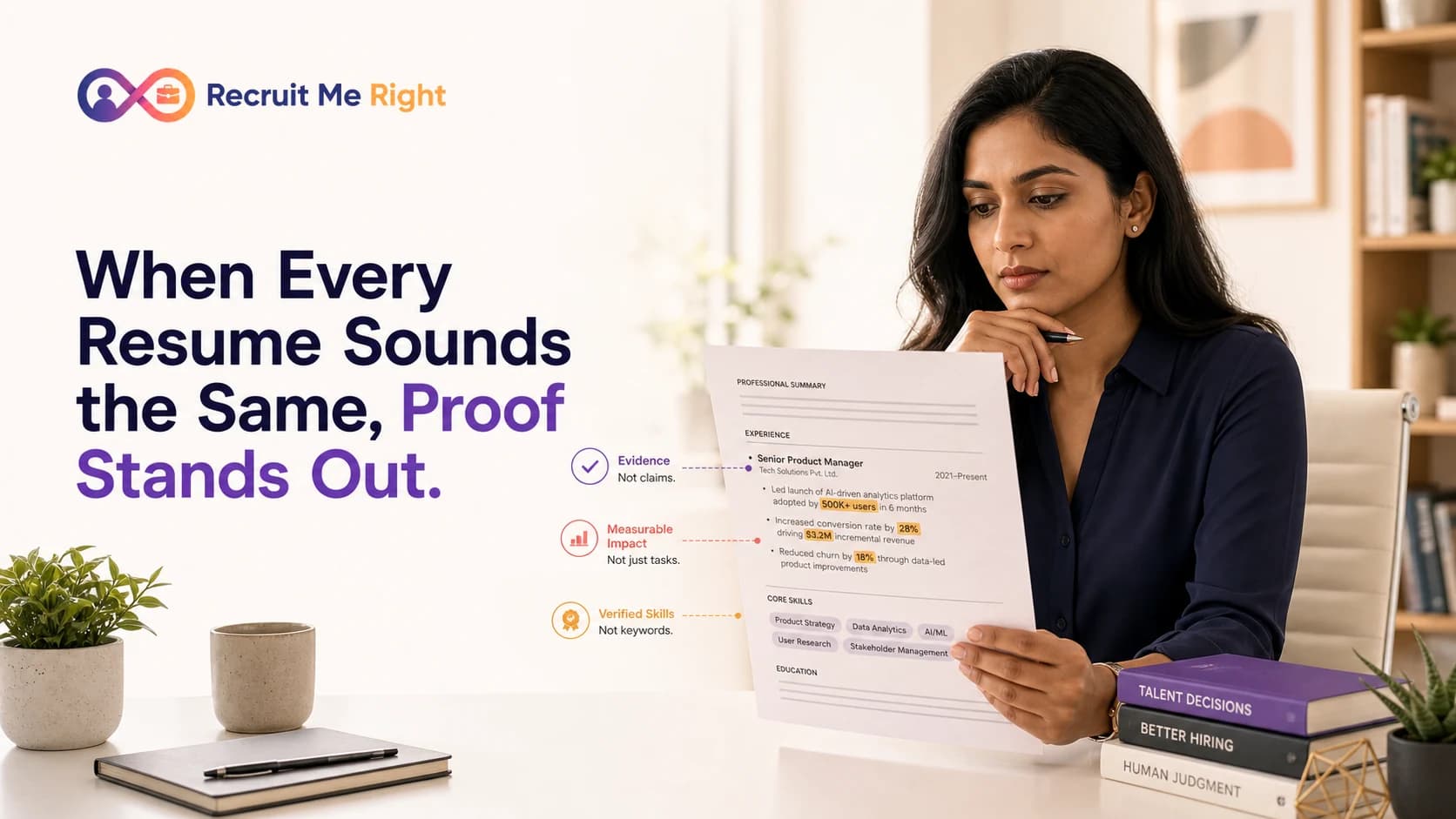
If your resume still relies on general claims, use our guide to making your resume stand out with credible evidence before your next application.
4. Ask One Low-Pressure Question
Your question should be easy to answer.
Useful options include:
- Are you able to share the expected timeline for the next stage?
- Is the team still reviewing applications for this position?
- Would any additional information or work samples be helpful?
Avoid questions that presume an outcome, such as “When can I schedule my interview?” You are expressing interest, not deciding the next step for the employer.
5. Close Professionally
Thank the reader, include your full name and add the phone number or LinkedIn URL already associated with your application. There is usually no need to attach the resume again unless you believe the original upload failed or the recruiter asks for it.
Job Application Follow-Up Email Samples
Templates are starting points. Replace the brackets, remove irrelevant lines and use details you can defend. A message that sounds like you will work better than one copied word for word.
Template 1: Follow-Up After an Online Application
Subject: Follow-up: [Job title] application — [Your name]
Hello [Recruiter's name],
>
I applied for the [job title] position on [date] and wanted to reaffirm my interest in the opportunity. The role's emphasis on [priority from the job description] aligns closely with my experience [brief proof or achievement].
>
I understand the team may still be reviewing applications. Are you able to share the expected timeline for the next stage?
>
Thank you for your time and consideration.
>
Regards,
[Full name]
[Phone number] | [LinkedIn URL]
Why it works: the message is specific, relevant and gives the recruiter one clear question to answer.
Template 2: Follow-Up After a Recruiter Asked You to Apply
Subject: Application submitted: [Job title] — [Your name]
Hi [Recruiter's name],
>
Thank you again for speaking with me about the [job title] position. I submitted my application today and highlighted my experience with [relevant skill, market or responsibility].
>
Our conversation strengthened my interest in the role, particularly [specific point discussed]. Please let me know if I can provide any additional information for the hiring team.
>
Best regards,
[Full name]
Why it works: it reminds the recruiter of the relationship and references an actual part of the conversation.
Template 3: Follow-Up After an Interview Timeline Has Passed
Subject: Follow-up on [Job title] interview — [Your name]
Hello [Name],
>
Thank you again for the conversation about the [job title] position on [interview date]. I enjoyed learning more about [specific team goal or challenge], and I remain very interested in contributing my experience in [relevant area].
>
You had mentioned that the team expected to share an update by [date], so I wanted to ask whether the timeline has changed. I appreciate that hiring decisions can take time and am happy to provide anything further.
>
Regards,
[Full name]
Why it works: it refers to the agreed timeline without accusing the employer of being late.
Template 4: Short LinkedIn Follow-Up
Hi [Name], I applied for the [job title] role on [date] and noticed that you recruit for [function/company]. My experience in [specific relevant area] appears closely aligned with the position. If you are the right contact, I would be grateful for any guidance on the hiring timeline. Thank you.
LinkedIn messages should be especially concise. The Harvard FAS career-services guidance on contacting recruiters recommends being clear about who you are, naming the role and keeping the message short and professional.
Do not send a connection request, email, direct message and comment on the recruiter's post on the same day. Choose one channel and give the person time to respond.
Common Follow-Up Mistakes That Can Hurt Your Application
Follow-up becomes uncomfortable when it shifts from useful context to repeated pressure.
Following Up the Next Day
Unless a recruiter asked you to confirm immediately, one day is rarely enough time for a team to review applications. An early message is unlikely to accelerate the process.
Writing Only “Any Update?”
The recruiter may not remember your name or know which role you mean. Always include the position and enough context to find your application.
Sending a Long Life Story
A follow-up is not a second cover letter. Keep it focused on the application, your strongest relevant evidence and the next step.
Contacting Several People at Once
Messaging a recruiter, hiring manager, department head and company founder can create confusion. It may also suggest that you do not respect normal working boundaries.
Inventing Another Offer
Do not claim you have a competing offer to force a faster answer. If you genuinely have a deadline, state it calmly:
I remain very interested in this role. I have been asked to respond to another offer by Friday, so I would appreciate any update you are able to share about my status or the likely timeline.
The employer still may not be able to decide by your deadline, but honest information allows both sides to plan.
Sounding Entitled
Phrases such as “I deserve an interview,” “Please respond immediately” or “I have been waiting long enough” create pressure without improving your candidacy.
Professional communication does not mean hiding your interest. It means expressing that interest while recognising that the other person may be working with information or constraints you cannot see.
Attaching Unrequested Files
Repeated attachments add clutter and can trigger security filters. Share a portfolio or work sample only when it strengthens a requirement in the role, and label the link clearly.
What If the Recruiter Does Not Reply?
No response is frustrating, but it is not an invitation to keep messaging.
After your first follow-up, wait several business days. If the role is still advertised and you remain strongly interested, send one final check-in:
Hello [Name], I wanted to make one final follow-up regarding my application for the [job title] position. I remain interested and would be glad to provide any additional information. I understand if the team has moved forward with other candidates, and I appreciate your consideration.
Then stop. Continue applying, networking and preparing for other opportunities.
The National Careers Service application guidance reminds job seekers that they may not hear back from every application and that applying for several suitable roles is normal. Keeping more than one opportunity active protects your momentum and reduces the temptation to over-focus on a single employer.
Silence may mean:
- The role has been paused or the budget is awaiting approval.
- The hiring manager's priorities changed.
- The team is reviewing candidates in batches.
- An internal candidate is being considered.
- The recruiter has not yet received feedback.
- The organisation contacts only shortlisted applicants.
- Your application was not selected.
You cannot identify the reason from silence alone. Treat the application as open until you receive a decision, but do not put the rest of your search on hold.
Keep an Application Tracker
A simple tracker helps you follow up based on facts instead of emotion.
Record:
- Company and exact job title
- Job link or job ID
- Date applied
- Resume version used
- Recruiter or hiring-manager contact
- Stated closing date or timeline
- First follow-up date
- Final follow-up date
- Interview notes and next step
- Current status
This habit prevents duplicate messages and reminds you which version of your experience the employer has seen. It also reveals patterns. If you submit many relevant applications but receive no interviews, review the positioning and common issues in your resume. Our guide to the resume mistakes recruiters notice first can help you diagnose the problem.
A Final Checklist Before You Press Send
Ask yourself:
- Have I respected the employer's stated timeline?
- Am I contacting the person most directly connected to the role?
- Does the subject line include the job title or ID?
- Have I mentioned when I applied?
- Did I include one specific reason I match the role?
- Is there one clear question?
- Can the message be read in under a minute?
- Is the tone calm, confident and respectful?
- Have I checked the person's name, company and spelling?
- Am I prepared to wait after sending it?
If the answer is yes, send the message and return your attention to the rest of your search.
The Best Follow-Up Creates Clarity, Not Pressure
A job application follow-up is not a persuasion trick. It cannot rescue a poorly matched application or force a hiring decision. What it can do is demonstrate professional communication, reinforce relevant evidence and help a busy recruiter respond with less effort.
Be specific. Be brief. Respect the timeline. Ask one useful question.
Then keep moving.
Your next opportunity should not depend on a single inbox. Explore the latest job openings, keep tailoring your applications and use each follow-up as a small example of how clearly you communicate at work.
Frequently Asked Questions
How long should I wait before following up on a job application?
Follow any timeline in the vacancy or confirmation email. When the employer gives no timeline, waiting about one to two weeks after applying is a reasonable general guideline. Hiring speed varies, so allow more time for senior, public-sector or complex roles.
Is It Better to Follow Up by Email or LinkedIn?
Email is usually the best first option because it is professional, searchable and less intrusive. Use LinkedIn when the recruiter invited contact there or when no appropriate business email is available. Do not use both channels at the same time.
What Should I Say in a Job Application Follow-Up?
Name the exact role and date you applied, restate your interest, give one concise piece of evidence that fits the job and ask whether the recruiter can share the next step or expected timeline.
Will Following Up Make Me Look Desperate?
One concise, respectful message usually communicates interest rather than desperation. Repeated contact, urgent demands or messaging several employees at once is more likely to create a negative impression.
What Should I Do If the Recruiter Does Not Reply?
Wait several business days before one final check-in. If there is still no reply, stop contacting the employer and continue with other suitable applications. A lack of response does not tell you why the process stalled.